
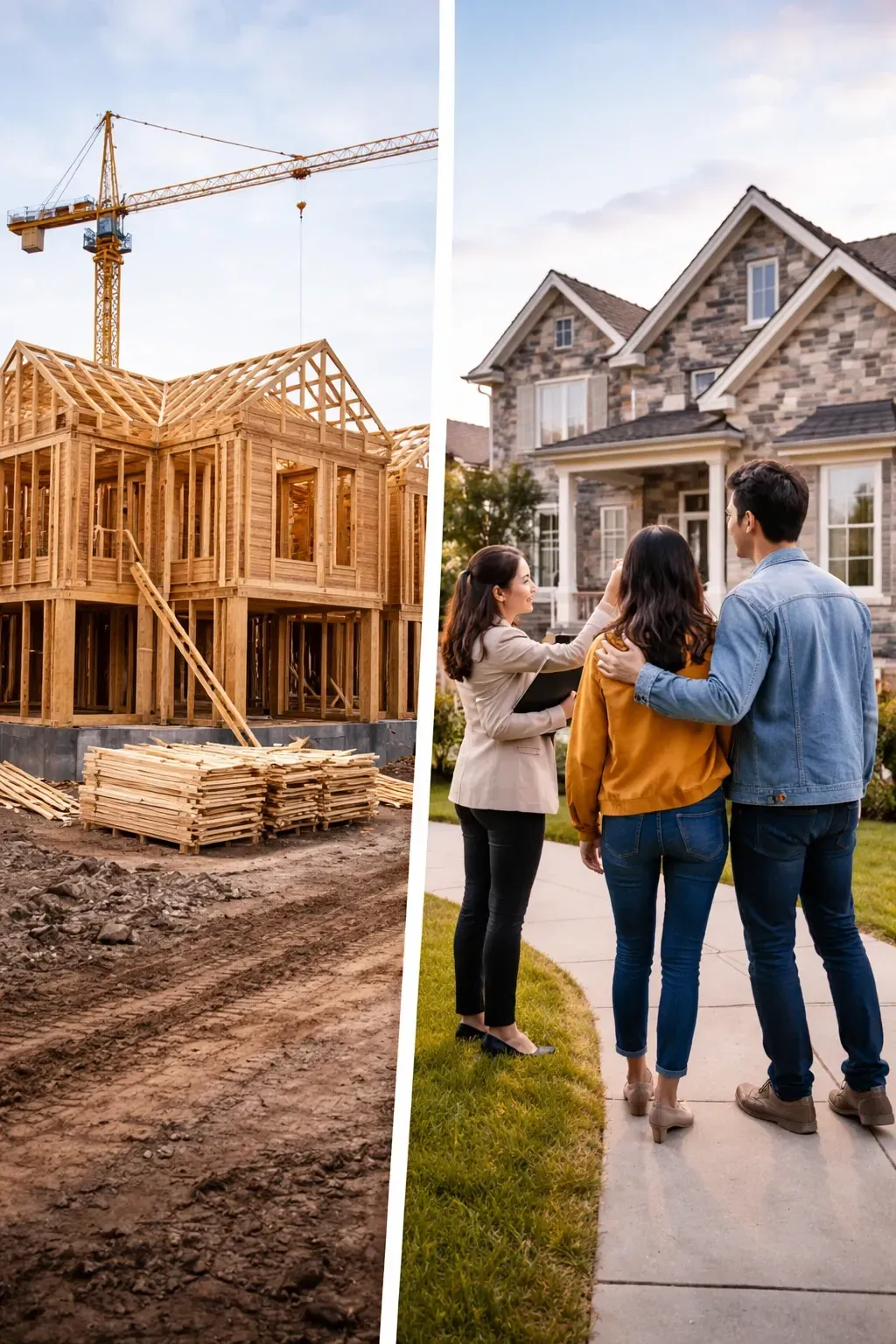
Building vs Buying vs Leasing in Ontario: Which Option Actually Makes Financial Sense?
In Ontario’s real estate market, the question is no longer whether housing is expensive. That is already established. The real question is where the opportunity sits.
For homeowners, investors, and entrepreneurs across Toronto and the GTA, the choice between building, buying, or leasing is not just a lifestyle decision. It is a capital allocation strategy.
And increasingly, the numbers are pointing in one direction.
The Cost Landscape in Ontario Today
The Ontario housing market has reached a level where traditional entry points are no longer as straightforward.
Buying a home in the GTA often approaches or exceeds the million-dollar mark. At the same time, rental prices continue to rise without offering any long-term return. Building, once seen as complex or inaccessible, is now being reconsidered by a growing number of buyers.
The reason is simple. When prices converge, control becomes more valuable than convenience.
Buying: Paying for What Already Exists
Buying an existing home remains the most common path, largely because it is familiar and immediate.
You find a property, secure financing, close the deal, and move in.
But in today’s market, buyers are often paying a premium for outdated layouts, aging systems, and limited flexibility. Renovations become an additional layer of cost, both financially and logistically.
More importantly, the upside is constrained.
You are purchasing a finished product in a competitive market. Appreciation may follow, but it is largely dependent on external factors rather than strategic input.
Buying delivers certainty. It does not necessarily deliver optimization.
Leasing: Flexibility Without Ownership
Leasing continues to serve a purpose, particularly for short-term flexibility.
For individuals relocating, testing a market, or preserving liquidity, renting removes the burden of ownership. There are no property taxes, no maintenance responsibilities, and no long-term commitments.
However, leasing operates as a pure expense.
Every payment leaves your control permanently. In a rising rental market, those payments increase over time without building equity or long-term value.
Leasing can be efficient in the short term. Over time, it becomes expensive in a different way.
Building: Where Strategy Meets Opportunity
Building a home in Ontario has traditionally been viewed as the most complex option. It requires planning, coordination, and patience.
But complexity often comes with leverage.
When you build, you are not simply purchasing a home. You are creating an asset.
Control Over Cost and Design
Unlike buying, where compromises are inevitable, building allows you to align the property with your exact needs.
Layout, materials, efficiency, and long-term usability are all decisions made upfront. This reduces the need for future renovations and ensures that the home functions as intended from day one.
Control is not just about aesthetics. It is about eliminating inefficiencies that cost money over time.
Land as the Real Asset
The most overlooked advantage of building is the land itself.
In Ontario, particularly in and around the GTA, land is a finite and appreciating resource. When you acquire land and develop it, you are creating value at two levels:
The underlying land
The structure built on top of it
This dual-layer value creation is where building begins to separate itself from buying.
A well-located piece of land, combined with a properly executed build, often results in a property worth more than the total cost to create it.
That gap is where equity is generated.
Forced Appreciation vs Market Appreciation
Buying relies on market appreciation. You purchase at a certain price and hope the market moves in your favor.
Building introduces forced appreciation.
By improving land, optimizing design, and controlling construction quality, you are actively increasing the value of the asset. This is not dependent on market timing. It is driven by execution.
For entrepreneurs and investors, this distinction is critical.
Income Potential and Expansion
Building also opens the door to additional strategies that buying does not always allow.
Basement apartments, secondary units, and multi-use layouts can be designed into the property from the start. This creates opportunities for rental income, multi-generational living, or future resale advantages.
In high-demand markets like Toronto and the GTA, these features are not just desirable. They are financially impactful.
The Risk Conversation
Building is not without risk.
Construction timelines can extend. Costs can fluctuate. Permits and approvals require navigation.
But these risks are increasingly being managed through experienced builders, structured planning, and fixed-scope contracts.
The key difference is that building risks are active and controllable, while buying risks are often passive and market-driven.
Comparing the Three Paths
When viewed purely through a financial lens, the differences become clearer.
Leasing offers flexibility but no long-term return.
Buying offers stability but limited upside beyond market growth.
Building offers control, customization, and the ability to create equity through execution.
As Ontario prices continue to rise, the gap between buying and building is narrowing. In some cases, it has already closed.
When the cost of buying an average home approaches the cost of building a tailored one, the decision shifts from convenience to strategy.
A Shift in Mindset Across the GTA
More homeowners across Toronto and surrounding regions are beginning to recognize this shift.
Instead of competing for existing homes, they are looking at land acquisition and development. Instead of accepting outdated layouts, they are designing properties that match current and future needs.
This is not a trend driven by aesthetics. It is driven by economics.
Where the Advantage Is Moving
The Ontario market is evolving.
Leasing will always serve short-term needs. Buying will remain the default option for many. But building is increasingly becoming the strategic choice for those thinking beyond immediate occupancy.
It requires more effort upfront. It demands planning. But it also offers something the other options do not.
Control over the outcome.
And in a high-cost market, control is where the real value is created.