The ABI Funding Gap: Why $65,000 Is Not Enough for Brain Injury Survivors in Ontario
On a Tuesday afternoon in late September, Jamie Davison walks to work through downtown Toronto. An associate at McLeish Orlando LLP, she is a frequent pedestrian in a city she describes as "not built for heavy pedestrian traffic". Since July 1, 2026, that commute has felt more precarious than it used to.
Davison is not alone in her concern. In the weeks since Ontario's Statutory Accident Benefits Schedule (SABS) underwent sweeping changes, personal injury lawyers across the province have been grappling with a question that has no easy answer: what happens to the most vulnerable accident victims when the safety net is pulled back?
For survivors of acquired brain injury (ABI), the answer is becoming painfully clear.
A System That Was Already Fragmented
The existing support landscape for ABI survivors in Ontario is not a single system. It is a patchwork of programs, each with its own eligibility criteria, capacity limitations, and waitlists.
OHIP covers medically necessary health services. Community and publicly funded programs offer additional support, but access is often frustrated by eligibility rules and capacity constraints. Private extended health benefits provide another layer, but they are tied to employment. When a person is unable to work, those benefits can disappear entirely.
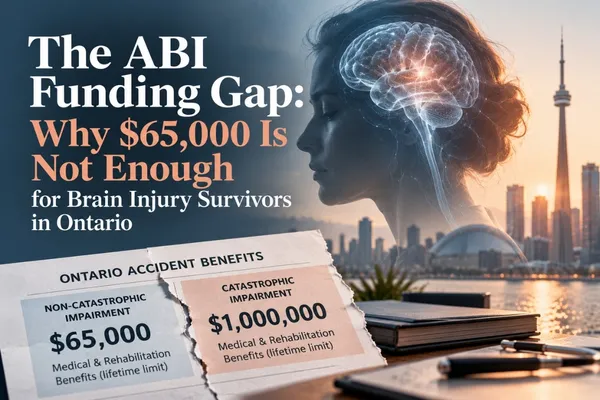
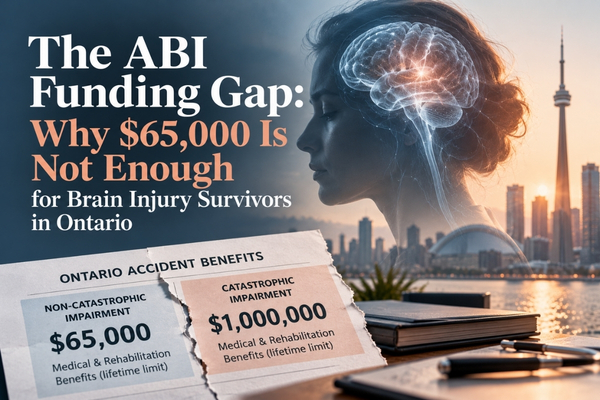
Under the SABS, the final layer of support was the accident benefits system. For those who qualified as catastrophically impaired, up to $1 million in medical and rehabilitation benefits was available over a lifetime. For those who did not qualify, the cap was $65,000 for non-catastrophic impairments.
That $65,000 limit covers both treatment and attendant care. For a badly injured person, it can be used up well before recovery is complete.
The Catastrophic Impairment Threshold
The difference between catastrophic and non-catastrophic designation is not a matter of degree. It is a matter of access.
A catastrophic impairment designation unlocks $1 million in medical and rehabilitation benefits, plus additional protections for income replacement and other services. A non-catastrophic designation caps medical and rehabilitation benefits at $65,000.
For ABI survivors, proving catastrophic impairment is notoriously difficult.
As Davison explains, reaching the catastrophic threshold through whole person impairment requires at least 53 per cent, which is then rounded up to 55. But for brain injuries, the most common physically measurable symptoms, such as medication use and headaches, rarely get anyone there. "Neither medication use nor headaches," Davison notes, "has gotten anyone there in my experience."
The alternative route is psychological. To qualify as catastrophically impaired through this path, an ABI survivor must prove at least three marked impairments in categories of mental and behavioural dysfunction. As Davison puts it, "which is not clear cut in any way, shape, or form when discussing someone with a brain injury."
The result is a gap that leaves ABI survivors in a kind of legal limbo. "The gap is when they're 12 to 16 months out from injury and debilitated in their ability to work or function, it's obvious from speaking to them that they qualify, but we have to pigeonhole them into one of the preexisting categories that can designate them catastrophically impaired," Davison explains. "There's no hole for them to be properly placed into. You have to apply for clients to fit into definitions that are awkward and in my view inaccurately reflect ABI impairments."
The Invisible Injury Problem
Part of what makes ABI so challenging in the accident benefits system is that it is often invisible.
Unlike a broken arm or an amputation, the level of impairment an ABI survivor lives with is rarely apparent to the people around them. A person may look fine. They may speak clearly. They may walk without difficulty. But behind that exterior, they may be struggling with memory loss, concentration problems, personality changes, and a loss of independence that is difficult to measure in the clinical terms the SABS requires.
Davison sees a parallel between the invisibility of ABI and the invisibility of the recent SABS changes. Both are easy to overlook. Both have the potential to be catastrophic.
"We are lucky enough at the firm to be integrated into this insurance world and be aware of the implications," she says. "I worry about those who simply haven't had the changes come across their desk."
What the July 1 Reforms Changed
The changes that took effect on July 1, 2026, under Ontario Regulation 383/24, reclassified most accident benefits from mandatory to optional. Only medical, rehabilitation, and attendant care benefits remain automatic in every policy. Income replacement benefits, which were previously automatic, are now optional.
This shift has profound implications for ABI survivors. Under the old system, a person who could not work after a brain injury could generally access income replacement benefits automatically. Under the new system, if they did not opt into that coverage, it will not be there.
The standard limits for the mandatory benefits have not changed. The $65,000 non-catastrophic cap remains. The $1 million catastrophic cap remains. But the path to accessing the catastrophic cap has not gotten any easier.
The Financial Reality for ABI Survivors
For an ABI survivor who does not qualify as catastrophically impaired, the $65,000 cap is not a generous allowance. It is a countdown.
Attendant care alone can cost $3,000 per month. At that rate, the $65,000 limit could be exhausted in 12 to 18 months, long before recovery is complete. Treatment expenses, rehabilitation therapies, and assessments add to the total.
Once the $65,000 is spent, the accident benefits system offers nothing further for medical and rehabilitation costs. The survivor is left to navigate OHIP, community programs, and private resources, if any remain. For many families, this means turning to savings, selling assets, or relying on family members to provide care that should be professionally delivered.
This is the reality that personal injury lawyers are now confronting. The SABS reforms did not just change the rules. They shifted financial risk from insurers to the most vulnerable accident victims.
The Role of Legal Representation
For ABI survivors and their families, navigating the post-reform landscape requires more than perseverance. It requires legal expertise.
The process of proving catastrophic impairment is complex and adversarial. Insurers have every incentive to deny catastrophic designation, because the difference between $65,000 and $1 million is enormous. Assessments must be carefully chosen. Medical evidence must be assembled. Legal arguments must be made.
This is where catastrophic injury lawyers who understand the ABI funding gap become essential. A lawyer experienced in catastrophic impairment claims can help assemble the evidence needed to meet the legal threshold, challenge insurer denials, and pursue the full benefits available under Ontario law.
For brain injury cases specifically, Toronto traumatic brain injury lawyers bring specialized knowledge of the medical and legal complexities involved in ABI claims. From concussion to catastrophic brain injury, this expertise can make the difference between a claim that is denied and one that is properly compensated.
Beyond the SABS: Tort Claims
When accident benefits are insufficient, tort claims become the remaining avenue for compensation.
A tort claim allows an injured person to sue the at-fault party for damages, including pain and suffering, future care costs, and income loss. Unlike the no-fault accident benefits system, tort claims are not capped by the SABS limits. But they are also not guaranteed. Liability must be proven. The defendant may not have sufficient insurance. The process can take years.
For ABI survivors, the combination of accident benefits and tort claims is often necessary to secure the resources they need for lifelong care. A lawyer who understands both systems is essential.
What Comes Next
The SABS reforms are less than four months old, and their full impact is still unfolding. What is already clear is that ABI survivors are among the most exposed groups under the new regime.
The challenges are both systemic and individual. Systemically, the fragmented support landscape and the difficulty of proving catastrophic impairment create gaps that leave vulnerable people without the resources they need. Individually, each ABI survivor and their family must navigate a complex system while coping with the effects of a life-altering injury.
For those who have been injured, the message is clear: understanding your rights, gathering the right evidence, and securing experienced legal representation is not optional. It is essential.
If you or someone you love has suffered a brain injury in an accident in Ontario, speaking with a lawyer who understands the SABS reforms and the catastrophic impairment threshold is the first step toward protecting your future.