
Ontario Auto Insurance Changes 2026: Are You Actually Covered?
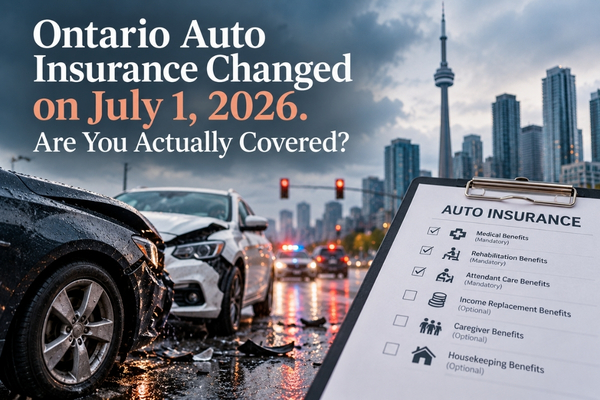
On a rainy Tuesday morning in October, a driver runs a red light at a busy intersection in Scarborough. The crash that follows sends a 34-year-old father of two to the hospital with a fractured pelvis and a traumatic brain injury. He will not work for at least eight months. His wife will need to take leave from her job to care for him. Their mortgage payment is due in two weeks.
Under Ontario's auto insurance system before July 1, 2026, this family would have had automatic access to income replacement benefits, caregiver benefits, housekeeping benefits, and other protections designed to prevent financial catastrophe after a serious collision.
Under the system that took effect on July 1, 2026, those benefits are no longer automatic. They are optional.
The question every Ontario driver now faces is a simple one with profound consequences: are you actually covered?
What Changed on July 1, 2026
On July 1, 2026, Ontario implemented the most significant overhaul of its Statutory Accident Benefits Schedule (SABS) in decades. Under Ontario Regulation 383/24, nine accident benefits that were previously mandatory in every auto insurance policy became optional. Only medical, rehabilitation, and attendant care benefits remain automatically included.
The benefits that are now optional include:
Income Replacement Benefits: Coverage for lost wages if you cannot work after an accident.
Non-Earner Benefits: Financial support for those who were not employed at the time of the accident.
Caregiver Benefits: Compensation for those who provide care to dependants but cannot do so after an injury.
Housekeeping and Home Maintenance Benefits: Coverage for assistance with household tasks you can no longer perform.
Lost Educational Expenses: Reimbursement for education disrupted by an accident.
Visitor Expenses: Coverage for family members who travel to support an injured person.
Damage to Clothing and Similar Items: Reimbursement for personal items damaged in a crash.
Death and Funeral Benefits: Support for surviving family members.
Medical, rehabilitation, and attendant care benefits remain mandatory. But even these have limits. The standard medical and rehabilitation benefit is capped at $65,000 for non-catastrophic injuries, an amount that critics say falls far short of what serious injuries actually require.
Why This Matters More Than You Think
The most significant consequence of the July 1 reforms is a fundamental shift in financial risk.
Before the changes, Ontario's auto insurance system functioned as a no-fault system. Regardless of who caused an accident, injured parties could access a baseline of benefits to cover medical costs, lost income, and other expenses. The system was not perfect, but it provided a safety net.
That safety net has been significantly reduced.
Under the new rules, the optional benefits apply only to named insureds, their spouses, dependants, and listed drivers. This means that if you are injured as a passenger in someone else's vehicle, as a pedestrian, or as a cyclist, you may not have access to the optional benefits that the driver purchased. Approximately 40 per cent of accident victims do not hold their own auto insurance policy, meaning a significant portion of injured road users will have access only to the reduced mandatory benefits.
For these individuals, the consequences of a serious accident can be financially devastating.
The Shift to Tort Litigation
As accident benefits shrink, more injured Ontarians are expected to turn to tort litigation to recover what they have lost. This means suing the at-fault driver for damages, a process that is more complex, more time-consuming, and more uncertain than accessing no-fault benefits.
The shift has significant implications. According to Jay Ralston, president of the Ontario Trial Lawyers Association, the reforms are "pushing more drivers into a tort system where a jury never learns who's actually footing the bill".
Ralston points to the statutory deductible, a little-known mechanism that applies to pain and suffering awards in motor vehicle accident claims. The deductible currently sits at $47,913.01 for 2026, indexed to inflation and increasing automatically every January 1.
Here is how it works: if a jury awards $100,000 in pain and suffering, the first $47,913.01 is deducted. The injured person walks away with roughly half of what the jury decided they deserved. The jury is never told about the deduction. The at-fault driver does not pay it. The insurer does not pay it either. It is, as Ralston describes it, "a complete bonus to the insurance company".
For injured Ontarians who are already navigating the loss of accident benefits, this is a second financial blow.
What the Tribunal Is Saying
The Licence Appeal Tribunal, which handles disputes over accident benefits, has been busy since the reforms took effect. A recent ruling from September 2026 illustrates the complexity of the new landscape.
In a case involving Aviva General Insurance, a claimant who was injured in a July 2021 car crash sought payment for six treatment plans. Adjudicator Jim Zotalis released his ruling on September 15, 2026, ordering Aviva to pay for three medical assessments but backing the insurer's refusal to pay for three treatment plans.
The ruling turned on a critical distinction. An assessment only has to clear a lower bar. Its job is to determine whether an injury is real, so the claimant needs only enough reason to look closer. A treatment plan is different. By the time a provider is billing for ongoing care, the claimant must show the treatment is actually working, not just that the injury is real.
The claimant won assessments for chronic pain, psychological, and orthopaedic evaluations, worth a combined $8,227.50. He lost chiropractic therapy and two physiotherapy plans, worth a combined $6,700.43. The tribunal found he had no referral from his family doctor and no records showing his pain was easing or his movement improving.
The case highlights a reality that injured Ontarians are discovering: even when you have a legitimate injury, proving entitlement to treatment funding is harder than it used to be.
What You Can Do Right Now
The most important step every Ontario driver can take is to review their auto insurance policy.
If you have not already done so, check whether you opted in to the optional benefits. Many drivers, focused on reducing premiums, may have declined coverage they now need. The savings from declining optional benefits are often modest. The financial consequences of being underinsured after a serious accident can be catastrophic.
For those who were injured in an accident before July 1, 2026, the old rules may still apply to your claim. The changes apply to policies renewed or entered into on or after July 1, 2026, but the rules governing your accident benefits depend on the date of your policy and the date of your accident.
If you have been injured in a collision, whether before or after July 1, 2026, the complexity of the new system makes legal guidance more important than ever. Toronto personal injury lawyers who understand the new accident benefits system can help you navigate the optional coverage rules, pursue the benefits you are entitled to, and evaluate whether a tort claim is appropriate. If your injuries are severe, you may also want to consult with a Toronto catastrophic injury lawyer who has experience with brain injuries, spinal cord injuries, and catastrophic impairment claims. And if you were injured in a fall on someone else's property, a Toronto slip and fall injury lawyer can help you pursue occupiers' liability claims.
The Road Ahead
Ontario's auto insurance reforms are less than four months old, and their full impact is still unfolding. What is already clear is that the shift from mandatory to optional benefits has transferred financial risk from insurers to drivers, passengers, cyclists, and pedestrians.
The province frames the reforms as a consumer choice measure. Critics describe them as a dismantling of protections for those who can least afford to lose them.
For Ontario drivers, the practical reality is this: the safety net that once existed after a serious accident is now smaller, more conditional, and more dependent on decisions made at the time of policy purchase. Understanding what your policy covers, and what it does not, is no longer optional. It is essential.
If you or someone you love has been injured in a motor vehicle accident in Ontario, understanding your rights under the new system is the first step toward protecting your recovery and your financial future.