
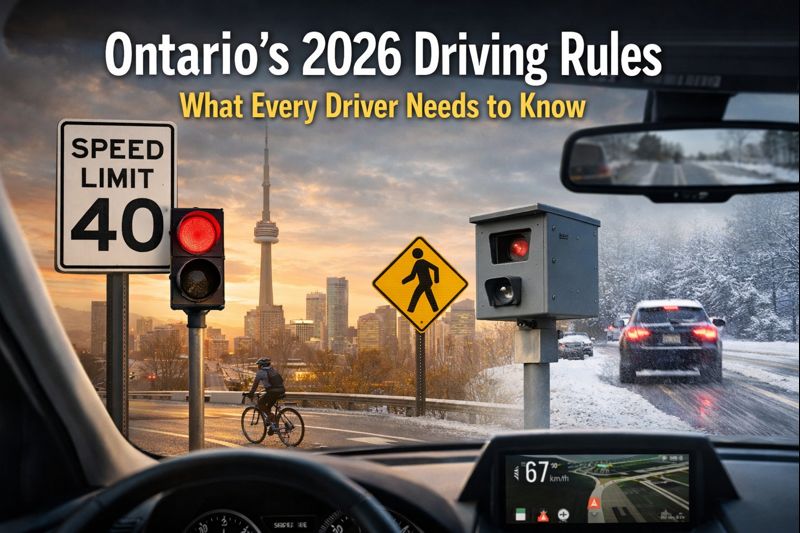
Ontario’s 2026 Driving Rules and What Every Driver Needs to Know
Ontario’s 2026 Driving Rules and What Every Driver Needs to Know
For most drivers, the rules of the road feel fixed. Stop signs are where they have always been. Speed limits inch upward or downward but rarely surprise. Licensing requirements change slowly, if at all. Yet beneath this surface stability, Ontario’s driving framework is undergoing a quiet but consequential recalibration.
By 2026, drivers across Ontario will find themselves operating under a set of expectations shaped less by tradition and more by data, demographics, and liability management. The changes are not dramatic in isolation. Taken together, however, they represent a shift in how responsibility, risk, and enforcement are distributed on Ontario roads.
This is not a story about new gadgets or headline-grabbing bans. It is about how driving is being redefined in an era of congestion, aging infrastructure, and rising insurance costs—and what that means for anyone who gets behind the wheel.
A Move Toward Outcome-Based Enforcement
One of the most important shifts underway is philosophical rather than technical. Ontario’s traffic enforcement approach is moving away from isolated infractions and toward outcome-based risk assessment.
Historically, a speeding ticket was just that: a discrete violation with a fixed penalty. Increasingly, enforcement agencies and insurers are looking at patterns. Repeated low-level offences, near-miss incidents captured by cameras, and even braking or acceleration behaviour can now factor into how risk is assessed over time.
This trend reflects a broader policy objective: reducing serious injuries rather than merely issuing citations. For drivers, the implication is clear. Safe driving is no longer measured only by avoiding tickets, but by maintaining a consistent record that demonstrates risk awareness.
Automated Enforcement Is Becoming the Norm, Not the Exception
Ontario has already expanded the use of red-light cameras and automated speed enforcement in school zones and community safety areas. By 2026, these systems are expected to play a much larger role, particularly in urban and suburban corridors where police presence is limited.
What is changing is not only the number of cameras, but their integration. Automated enforcement data is increasingly cross-referenced with collision statistics, traffic flow models, and insurance claims. This allows municipalities to justify enforcement expansions as evidence-based safety measures rather than revenue tools.
For drivers, this means fewer discretionary warnings and more standardized enforcement. Cameras do not exercise judgment. They do not respond to explanations. They record behaviour, and the system responds accordingly.
Distracted Driving Rules Are Being Tightened Through Interpretation
Ontario’s distracted driving laws have been on the books for years, but enforcement and interpretation continue to evolve. By 2026, drivers should expect a narrower margin of tolerance, not because the law itself has changed dramatically, but because its interpretation has.
Courts and regulators are increasingly treating distraction as a behavioural category rather than a single act. Holding a phone is no longer the sole focus. Touching, glancing, or interacting with in-vehicle systems at the wrong moment can now form the basis of a charge if it contributes to unsafe operation.
The practical effect is that responsibility is shifting from device-specific prohibitions to a broader expectation of attentiveness. Drivers are being asked, in effect, to manage their own cognitive load—and will be judged accordingly if something goes wrong.
Graduated Licensing Is Being Viewed Through a Risk Lens
Ontario’s graduated licensing system has long been framed as a rite of passage. Increasingly, it is being treated as a risk management tool.
There is growing emphasis on early driving behaviour as a predictor of long-term safety. Data from insurance providers and transportation researchers suggests that habits formed during the G1 and G2 stages often persist. As a result, policymakers are examining whether additional restrictions, monitoring, or education should apply during these early years.
For new drivers and their families, the message is subtle but important. Early mistakes are no longer easily dismissed as learning experiences. They can carry long-term consequences for insurance eligibility and licensing progression.
Commercial and Rideshare Drivers Face Higher Scrutiny
As rideshare and delivery services have become embedded in Ontario’s transportation ecosystem, regulators have been forced to reconcile private vehicle rules with commercial realities.
By 2026, drivers who use their personal vehicles for commercial purposes should expect clearer distinctions in enforcement and liability. This includes stricter documentation requirements, more rigorous insurance scrutiny, and heightened expectations around vehicle maintenance.
The rationale is straightforward. When private vehicles function as de facto commercial fleets, the risk profile changes. Ontario’s regulatory response reflects an effort to align responsibility with usage, even when ownership remains private.
Winter Driving Expectations Are Being Redefined
Ontario winters are not new, but the legal expectations surrounding winter driving are evolving. Courts and insurers are increasingly treating winter conditions as a foreseeable risk rather than an exceptional circumstance.
This has implications for liability. Failing to adjust speed, following distance, or equipment to winter conditions is less likely to be excused as unavoidable. In some cases, winter tires, while not universally mandated, are being treated as a baseline expectation in post-collision assessments.
The result is a higher standard of care during winter months. Drivers are expected not only to react to conditions, but to anticipate them.
Insurance Is Becoming a De Facto Regulator
Perhaps the most significant driver of change is not legislation, but insurance economics. Rising claim costs, longer recovery periods, and more complex injury profiles have pushed insurers to exert greater influence over driving behaviour.
Telematics programs, premium adjustments based on driving patterns, and more aggressive fault analysis are increasingly common. By 2026, insurance consequences may outweigh legal penalties for many drivers.
This dynamic effectively turns insurance providers into parallel regulators. While they do not write traffic laws, they shape behaviour through financial incentives and penalties that drivers feel immediately.
Pedestrians and Cyclists Are Being Prioritized by Design
Ontario’s road design philosophy is shifting toward vulnerability-based prioritization. Pedestrians and cyclists, as the most exposed road users, are being afforded greater protection through infrastructure and enforcement.
This includes expanded right-of-way protections, lower default speed limits in mixed-use areas, and stricter penalties for drivers involved in collisions with vulnerable road users.
For drivers, this means that responsibility in shared spaces is increasingly asymmetric. The burden of care rests more heavily on those operating heavier, faster vehicles.
What This Means for Everyday Drivers
The cumulative effect of these changes is not to make driving impossible, but to make it more accountable. Ontario’s 2026 driving environment rewards predictability, attentiveness, and risk awareness. It penalizes inconsistency and complacency.
Drivers who adapt—by understanding how enforcement, insurance, and liability intersect are unlikely to feel constrained. Those who rely on outdated assumptions about discretion and forgiveness may find the system less accommodating than it once was.

A Quiet but Lasting Shift
Ontario’s driving rules are not being rewritten in bold strokes. They are being refined through interpretation, technology, and economic pressure. The result is a system that looks familiar, but behaves differently.
For drivers willing to pay attention, the path forward is clear. Driving in 2026 is less about knowing the rules and more about understanding how they are applied. In that distinction lies the future of Ontario’s roads.