
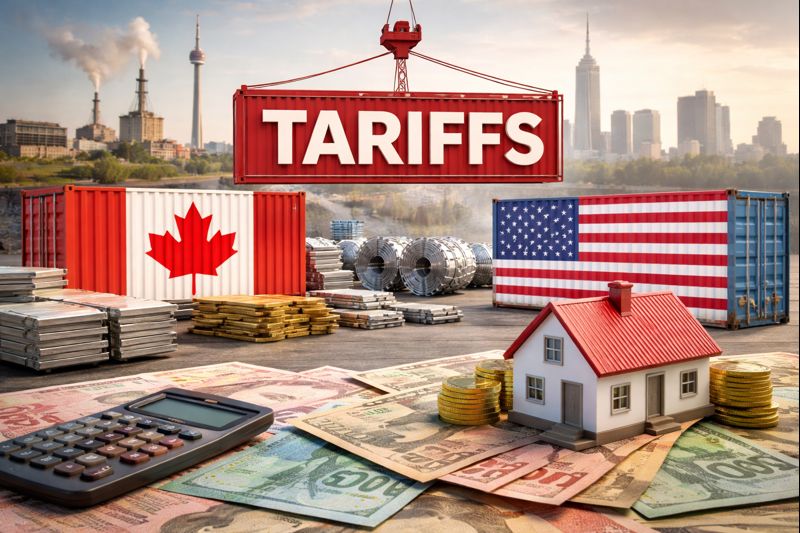
How US Tariffs Are Quietly Reshaping Ontario Households and What Families Can Do About It
Tariffs are often discussed as abstract tools of trade policy. They appear in headlines during election cycles or diplomatic disputes, then fade from view. Yet for households in Ontario, the impact of United States tariff policy has been neither abstract nor temporary. It has been tangible, persistent, and increasingly visible in everyday costs.
During the Trump administration, tariffs were used aggressively as a lever of economic pressure. Steel, aluminum, manufacturing components, agricultural goods, and a wide range of intermediate products were targeted. While the stated objective was to protect domestic American industry, the effects extended well beyond US borders. Ontario, with its deep integration into North American supply chains, has been particularly exposed.
The result has been a gradual but meaningful shift in prices, employment dynamics, and household financial pressure across the province.
Why tariffs matter to Ontario more than most regions
Ontario is not a distant trading partner of the United States. It is one of its most interconnected. Manufacturing corridors stretch across the border. Auto parts cross back and forth multiple times before a vehicle is completed. Steel and aluminum sourced in Canada are foundational to American production, just as American inputs are critical to Ontario factories.
When tariffs are imposed at any point in this chain, costs compound. A tariff applied to raw steel raises the cost of parts. Those higher costs are passed to manufacturers. Manufacturers pass them to distributors. Distributors pass them to consumers. By the time the effect reaches an Ontario household, it shows up as a higher price for a car, an appliance, or even a home renovation.
Unlike temporary supply disruptions, tariffs tend to linger. Even when they are reduced or removed, pricing rarely returns to prior levels. Businesses adapt to higher cost structures and households absorb the difference.
The household cost of tariff driven inflation
For Ontario families, tariff related inflation has surfaced in subtle but relentless ways. Vehicles have become more expensive, not only because of global demand but because the cost of components has increased. Home construction and renovation costs have risen as steel and aluminum prices climbed. Appliances, tools, and household goods that rely on imported components have followed the same trajectory.
Food prices have also been affected. Tariffs on agricultural goods and packaging materials raise costs throughout the supply chain. While a single price increase may seem modest, the cumulative effect across groceries, utilities, transportation, and housing has materially altered household budgets.
This pressure is especially acute for middle income families who lack the financial flexibility to absorb sustained increases without adjusting spending or taking on additional debt.
Employment uncertainty and wage pressure
Tariffs are often framed as job protecting measures. In practice, their effects are uneven. While some sectors may benefit in the short term, others experience disruption. Ontario manufacturing has felt both sides of this equation.
Higher input costs can make Ontario producers less competitive globally. Margins tighten. Investment decisions are delayed. Hiring slows. In some cases, production shifts elsewhere. For workers, this translates into job uncertainty or wage stagnation rather than the stability tariffs are meant to provide.
Households experience this not only through employment risk but through diminished income growth. When wages fail to keep pace with rising costs, purchasing power erodes even if employment remains stable.
Housing and household debt pressures
Tariff driven inflation intersects with housing in complex ways. Higher construction costs contribute to higher home prices and slower development. Renovations become more expensive, reducing the ability of homeowners to upgrade or adapt existing properties.
At the same time, households already carrying high levels of mortgage debt face increased pressure as overall living costs rise. Even without interest rate changes, higher day to day expenses reduce financial resilience. This can force difficult decisions around refinancing, downsizing, or short term borrowing to manage cash flow.
While tariffs are not the sole driver of these challenges, they are a contributing factor that compounds existing vulnerabilities in Ontario housing markets.
Why the effects persist
One of the most misunderstood aspects of tariffs is their persistence. Even after policy changes, the economic effects often remain. Contracts signed during tariff periods lock in higher pricing. Supply chains reconfigure in ways that do not easily reverse. Businesses adjust expectations and pass costs forward rather than absorbing them.
For households, this means that tariff impacts are not confined to the period when tariffs are actively in force. They become embedded in the cost structure of everyday life.
What Ontario households can do now
While households cannot influence trade policy, they can take steps to mitigate its effects.
First, budgeting assumptions should reflect a higher baseline for costs. Waiting for prices to fall back to previous norms is often unrealistic. Planning for stability rather than reversal allows for better long term decision making.
Second, households should prioritize financial flexibility. Maintaining access to savings or short term financing options can help manage timing gaps caused by job changes, property transactions, or unexpected expenses.
Third, debt exposure should be reviewed carefully. Rising costs magnify the risk of over leverage. Reducing reliance on high interest or variable obligations where possible can improve resilience.
Fourth, professional advice should be grounded in local conditions. Generic financial strategies often overlook Ontario specific realities such as provincial taxation, housing regulations, and cross border trade exposure.
Looking ahead
Tariffs are likely to remain a recurring feature of global trade policy. Regardless of political leadership, economic nationalism and supply chain protection have become enduring themes. For Ontario households, this means that tariff related pressures are not a temporary anomaly but part of a broader economic environment.
Understanding how these policies filter down from trade negotiations to grocery bills and mortgage decisions is essential. So is accepting that resilience now depends less on predicting policy changes and more on building household financial structures that can absorb them.
Ontario families that plan with realism, flexibility, and awareness will be better positioned to navigate the next phase of economic adjustment shaped by forces well beyond provincial borders.